
Recommended: Best knife sharpening method — precision vs whetstones
Why Nakiri Knives Are Ideal for Preparing Vegetables
The Nakiri knife is one of the most efficient kitchen tools for cutting vegetables. Designed with a straight blade edge and a rectangular profile, Nakiri knives excel at precise slicing, chopping, and dicing. This traditional Japanese vegetable knife has become increasingly popular among home cooks who want better control and efficiency during food preparation.
Japanese kitchen knives are known for their precision and balance. If you are exploring different knife styles, our guide to types of knives and their uses explains how Nakiri knives compare to other kitchen blades.
The Nakiri’s flat cutting edge allows the entire blade to make contact with the cutting board during each cut. This design prevents ingredients from sticking together and helps produce clean, uniform slices.


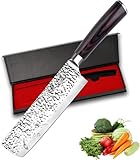
Last update on 2026-09-20 / Affiliate links / Images from Amazon Product Advertising API
Browse Nakiri knives on Amazon
What Makes a Nakiri Knife Unique
Unlike Western chef knives, Nakiri knives feature a completely flat cutting edge and squared blade profile. This design allows the knife to move straight up and down during chopping motions.
The thin blade geometry also helps the knife glide through vegetables with minimal resistance, producing smooth and consistent cuts.
Why Nakiri Knives Are Popular with Home Cooks
Home cooks often appreciate Nakiri knives because they are easy to control and efficient when cutting vegetables. The straight blade edge ensures that ingredients remain in contact with the cutting board, reducing the need for repeated cuts.
This makes Nakiri knives particularly useful when preparing large quantities of vegetables for soups, stir-fries, or salads.
Blade Steel and Edge Retention
Many Nakiri knives are made from high-quality steels such as VG-10 or high-carbon stainless steel. These steels provide excellent sharpness and long-lasting edge retention.
Regular maintenance is important for preserving performance. Our article on how often you should sharpen a Japanese knife explains how to maintain optimal cutting performance.
Nakiri vs Santoku
Nakiri knives are sometimes compared with Santoku knives because both are popular Japanese kitchen knives. However, their designs differ significantly. Santoku knives typically have slightly curved edges, while Nakiri knives maintain a completely flat edge.
We explore these differences further in our comparison of Gyuto vs Santoku knives, which highlights how various Japanese knives are used.
Final Thoughts
If you prepare vegetables frequently, a Nakiri knife can dramatically improve efficiency in the kitchen. Its flat blade, thin edge, and balanced design make it an excellent tool for precise vegetable preparation.
For many home cooks, adding a Nakiri knife to their kitchen quickly transforms the way they handle everyday food preparation tasks.